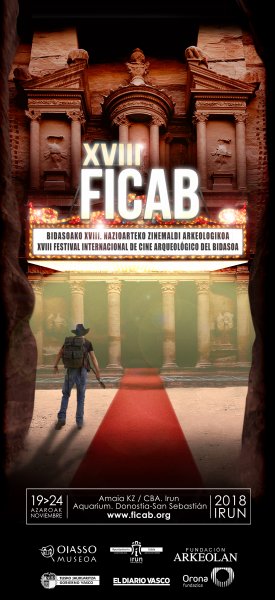
18th International Archaeological Film Festival of the Bidasoa
Awards
-
Grand Prize of the Festival: "The harem of the Sun Pharaoh" by Richard Reisz.
-
Special Audience Prize: "Easter Island: the moment of truth" by Thibaud Marchand.
- Orona Fundazioa Prize of the Educational Section: "Govan Young", by David Archibald.
-
Orona Fundazioa Special Mention of the Educational Section: "Archaeological research: Choquequirao, the sacred geography of the Incas" and "Archaeological research: The forgotten history of the Swahili", by Agnès Molia.
- Arkeolan Prize for Contribution to Science: "Roman engineering: aqueducts II" by José Antonio Muñiz.
Television is a communications medium that is often reviled. Witness the name “gogglebox” by which it is usually known. However, as happens with all technological media that have worked their way into our everyday lives and that are now taking the form of new technologies and social media, bad use can be made of it or it can become a fantastic medium for disseminating scientific knowledge and, in our case, archaeological research. In this edition of the International Archaeological Film Festival of the Bidasoa, which comes of age this year, we have received several chapters from up to four television documentary series. While it is true that most of the films that we show each year end up being shown on TV, the difference with these items is that they are not medium-length or full-length films on a single subject but have been created, right from the start, as a conceptual unit which, with the same format and a half-hour duration, discusses different topics. They also share a profound intention to educate, entertaining language and a dynamic pace, which make these TV programmes a fantastic tool for entertainment, learning and culture.
Specifically, this commitment to the educational value of the selected documentaries has promoted the consolidation of the Educational Section, which this year, for the first time and thanks to the contribution of Orona Fundazioa, will have its own award. The Festival therefore includes the Official Section, with 22 films competing for the Grand Jury Prize, and the Educational Section, with another 14 films entered for the Orona Prize. The 36 films selected will also be entered for the Public Choice Award and the Arkeolan Prize.
These are not the only special features of the 18th FICAB. In a year in which feminist claims have been the order of the day, it only remains to point out the substantial presence of women in the festival’s films: from archaeologists such as Sarah Rudolfs, director of excavations in the important Palaeolithic cave of Hohle Fels, or Myriam Seco, manager of the research taking place on the temple of Thutmose III in Egypt, to documentary directors such as Tamara Spitzing or Nagore Rementeria, as well as female historians, Egyptologists, epigraphists, geneticists, conservators, restorers and many more. Because, as in other fields, in Archaeology we also have a lot to say.
technical information
FICAB XVIII
Year: 2018
Data:: 19th - 24th of November
Organising Committee
Juncal Eizaguirre. Delegada de Cultura del Ayuntamiento de Irun.
Josean Ruiz de Azúa. Director
del área de Cultura y Deportes del Ayuntamiento de Irun.
Cristina Aguirre. Director of the Oiasso Roman Museum.
Elena Torregarai. Scientific responseable of the Oiasso Roman Musuem.
Direction
María José Noain. Head of Activities of the Oiasso Roman Museum.Educational Section
Itsaso Bikuña. Idoia Castro. Education Department.
Jury
President:Mònica Borrell. Director of the National Archaeological Museum of Tarragona.
Vocals:
Peter Eeckhout. Archaeologist and teacher of the Free University of Brussels.
Juan Miguel Gutiérrez. Director of cinema.
Jone Karres. Journalist and director of cinema.
Oriol Vicente. Archaeologist of the Autonoma University of Barcelona.
- PROGRAM
Monday, 19 November 2018
19:00. Festival opening ceremony
19:30. The Azilian puzzle. Production: CNRS Images. Direction: Villain, Alexis. Francia, 2018, 6. Language: Francés.

In the forest of Plougastel-Daoulas, in Brittany, fragments of plates of schist have been discovered decorated with abstract and naturalist engravings. These pieces have been dated back to the ancient Azilian period, around 14,000 years ago. This Prehistoric age, about which we still know very little, marks the transition between the End of the Upper Palaeolithic and the Epi-Palaeolithic Eras. Although the function of these plates is yet unknown, studying them will be able to tell us more about how people lived during this period.
19:35. Experiencing Archaeology: Ice Age Mission. Production: Südwestrundfunk (SWR). Direction: Spitzing, Tamara. Alemania, 2018, 45. Language: Alemán.
The relationship between Neanderthals and Homo Sapiens is one of the questions that has aroused most interest in recent years, both among researchers and the general public. Genetic analyses are showing surprising results. How, in Europe around 40,000 years ago was a new culture born, which incorporated art and music for the first time? The archaeological remains in southern Germany, among which are those from the Hohle Fels Cave, have a lot to tell us about this.
20:20. Mysteries of the infra-world: Teotihuacan. Production: Minotauro Producciones. Direction: Flores, Eduardo. México, 2017, 44. Language: Castellano.

Teotihuacan (Mexico) was one of the most spectacular cities in Pre-Columbian America. This documentary presents the exploration of a thousand-year-old tunnel below one of the oldest structures at the emblematic site: the Quetazlcoatl or Feathered Serpent Pyramid. With the use of modern technology, this film looks at how the ancient inhabitants of this place got to know and changed their surroundings to build one of the most advanced and sophisticated cities in the world at that time.
Tuesday, 20 November 2018
11:00. Aralar, pastoral heritage. Production: Elhuyar Fundazioa. Production: EITB. Direction: Leturia, Iñaki Direction: Rementeria, Nagore. España, 2018, 14. Language: Euskera.

The Sierra de Aralar is an enclave especially rich in prehistorical remains. In this report from the Teknopolis Programme, Professor of the University of the Basque Country, Joxean Mujika, offers a tour of its most representative remains, among which can be found dolmens, menhirs and cromlechs. As well as getting to know these important megalithic constructions, we will discover the latest finding made by archaeologists: a place inhabited around 5,000 years ago.
11:15. Roman Bobadela: splendidissima civitas. Production: Arqueohoje. Direction: Lamy, Rui Pedro. Portugal, 2018, 20. Language: Portugués.

We don’t know the exact name of the Roman city that was located in what is now Bobadela, in Portugal, but we do know that the Romans called it a “splendidissima civitas", in other words, a splendid city. Founded under the Emperor Augustus, it had some of the spaces and buildings typical of a Roman city: the forum and the amphitheatre where the gladiator combats took place. These monumental public spaces showed the importance of the city, which was the capital of an administrative district and a vast territory.
11:35. The UAB Archaeology and Palaeontology Campus: the Roman villa of Torre Llauder. Production: Servei Audiovisual i Multimèdia ICE-Universitat Autònoma de Barcelona. Direction: Sallès, Vicenç. España, 2017, 8. Language: Catalán.
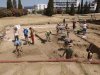
The Archaeology and Palaeontology Campus of the Autonomous University of Barcelona is a network of archaeological sites, museums and archaeological parks where the university carries out its research and teaching. The campus has several sites distributed throughout the territory which date from various periods and offer students the opportunity to train in field work. This short film presents the Torre Llauder site, a Roman villa located in the territory of the city of Iluro, present-day Mataró.
Cine Arqueologico del Bidasoa
Museo Romano Oiasso
Eskoleta, 1. 20302 Irun
Tfno.: (+34) 943-63 93 53
E-mail: ficab.oiasso@irun.org
 Facebook