


 Bidasoko Nazioarteko Zinemaldi Arkeologikoa
Festival Internacional de Cine Arqueológico del Bidasoa
Bidasoko Nazioarteko Zinemaldi Arkeologikoa
Festival Internacional de Cine Arqueológico del Bidasoa
CNRS Images
Details
- Contact: Christine Chapon (christine.chapon@cnrs.fr)
- Country: Francia
Films
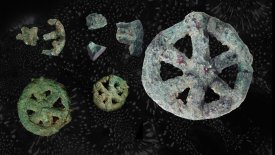
Discovered in Pakistan in 1985, the 6,000-year-old
Mehrgarh amulet has long remained an enigma. Thanks to new analysis techniques,
a team of researchers has managed to unveil the secrets of how this copper
amulet was made, the first known object made using the lost-wax casting
technique, fundamental in the history of the art of foundry.
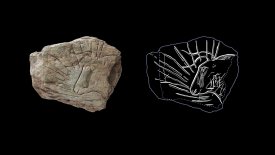
In the forest of Plougastel-Daoulas, in Brittany, fragments
of plates of schist have been discovered decorated with abstract and naturalist
engravings. These pieces have been dated back to the ancient Azilian period,
around 14,000 years ago. This Prehistoric age, about which we still know very
little, marks the transition between the End of the Upper Palaeolithic and the Epi-Palaeolithic
Eras. Although the function of these plates is yet unknown, studying them will
be able to tell us more about how people lived during this period.
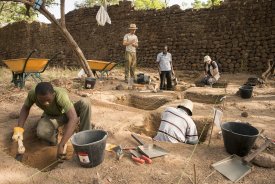
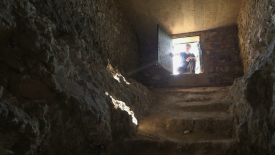
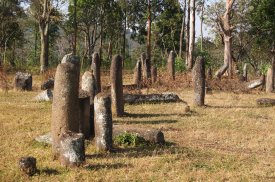
Discovered in 1902, the thousand-year-old
Loropeni ruins represent the only evidence of fortified architecture in the African
region of Lobi in Burkina Faso. An international research team has set up a
multidisciplinary research process in order to try and cast light on the
secrets which surround this archaeological site and its history.
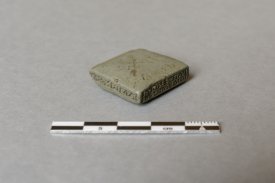
Doctors in ancient Rome prepared oculist
stamps, small stones etched with the names of the oculist and the remedies they
used. Muriel Labonnelie is a specialist in ancient medicine who has studied
these curious, seemingly insignificant pieces, which have allowed her to
uncover extensive information on the history of Roman medicine.
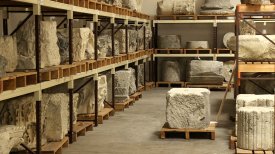
Dominique Tardy and Jean-Jacques Malmary,
members of the French Institute for Research on Ancient Architecture, have
identified the origin of certain architectural blocks discovered in Bordeaux
while the walls were being dismantled in the 19th century. These 400 pieces, a
large part of which are preserved and exhibited in Aquitaine Museum, have been
a mystery for a very long time, given the lack of historical context and the
difficulty in establishing which monument they came from.
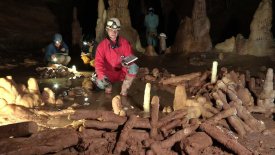
The recent discovery of a series of broken
stalagmites placed in a circle in Bruniquel Cave in south-eastern France
indicates that humans began to dwell in caves much earlier than previously
believed. These anthropic structures are among the oldest in human history.
Moreover, the remains of fire show that Neanderthals knew how to light up
closed, dark spaces even before Homo Sapiens did.
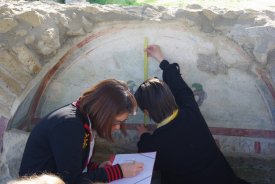
The Jean Bérard Centre in Naples began a
multidisciplinary study in 2012 to document the exceptional wall paintings
found in a monumental tomb from Roman times discovered in 2006, at the site of
Cumae (Italy). The results obtained over the last three years bring new
perspectives giving the mausoleum a second lease of life. The challenge is to
get the best solution for the protection and enhancement of this heritage.
Official Section. Place:
Amaia K.Z. (Irun)

The excavations carried out in 2009 on the
Palatine Hill in Rome, by a French and Italian team of archaeologists,
discovered the ruins of a building from the time of the Emperor Nero with some
very special features. It is a circular construction that seems to have served
as a support for some complicated machinery. It is believed to have been used
to rotate the table in the main dining room of the emperor’s palace. In this
documentary, based on the account from the historian Suetonius, the iconography
present on coins and the archaeological dig, we are offered a hypothetical
reconstruction of the mechanism.
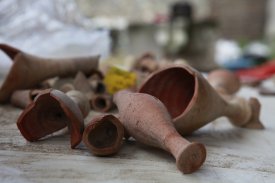
At the key settlements of Campania (Italy), namely Pompeii, Herculaneum
and Paestum, recent archaeological discoveries have given us further
insight into the perfumes manufactured and used in antiquity.
Archaeologists, philologists, epigraphers, chemists and perfumers are
working together to recreate the fragrances of an ancient perfume, the
perfume of the rose of Italy.
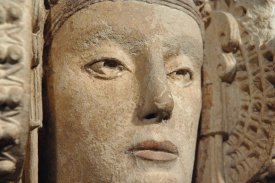
The Lady of Elche is more than just an extraordinary sculpture of
Iberian cultural tradition, as is revealed by her popularity. The
sculpture has had an eventful history between its discovery and eventual
siting in the Museum of Archaeology of Madrid. This time, an
alternative vision is offered, far removed from these iconic aspects,
that takes us back to the quarrying of the stone used to carve this
enigmatic, elegant and evocative female bust.
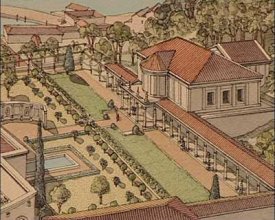
This
documentary shows us the way of working of Jean-Claude Golvin, a
well-known architect and archaeologist who was dedicated to the
restoration of archaeological sites using a technique which combines
scientific reconstruction and artistic talent.

After six centuries of existence, the tower of Vincennes, a medieval
building which is unique in Europe, is going to be restored as part of a
singular project. The film allows us to see all stages of the process,
including the archaeological excavation prior to the intervention.
The burial mound of Péré, located in Deux-Sèvres (France) is a Neolithic
burial ground dating back 6,500 years which has kept its funeral
chamber intact, allowing the archaeologists Roger Joussame, Luc Laporte
and Chris Scarre to study the funeral rituals of the time.